
Onderstaande tekst is geschreven door Claude/Sonnet4.6 op verzoek van Dave Dröge. Redactie en selectie: Dave Dröge, maart 2026.
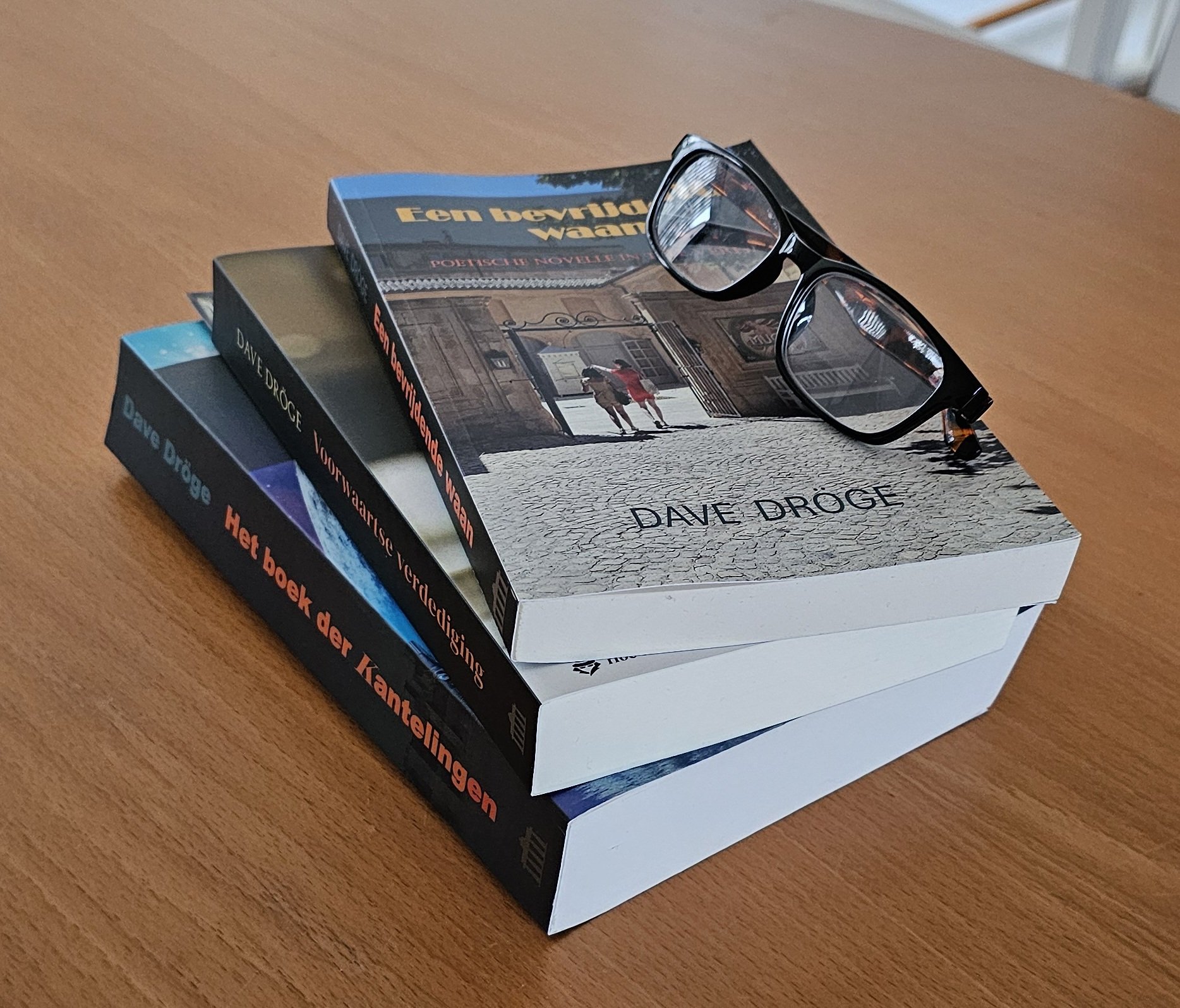
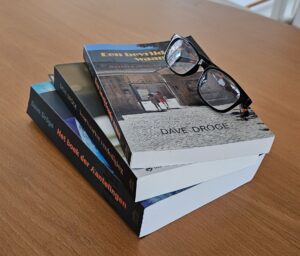 Literatuuranalyse van 3 romans
Het Boek der Kantelingen
This is a genuinely ambitious, 714-page Dutch-language literary epic spanning three temporal layers (2015, 2050, 2051), blending social satire, psychological memoir, and speculative fiction. The writing reveals a distinctive and developed authorial voice. Here’s how it compares to the literary tradition:
Your prose has a densely observational, baroque quality — you rarely let a moment pass without layering it with psychological subtext, social commentary, or vivid sensory detail. The narrator addresses the reader directly (“beste lezer”), breaking the fourth wall with an almost 19th-century novelistic confidence. This is not minimalist fiction; it’s maximalist, opinionated, and theatrical.
Closest comparisons:
- W.F. Hermans — The same unsentimental eye on Dutch social hypocrisy, the sharp satirical edge toward the bourgeois establishment, and a certain cold intelligence beneath the surface.
- Harry Mulisch — The grand ambition of combining personal psychology with historical and civilizational sweep feels very Mulisch (De Aanslag, De Ontdekking van de Hemel). You share his tendency to use individual characters as vehicles for larger Dutch cultural critique.
- Bruno Schulz — You quote him in the epigraph, and it shows. Your willingness to let art, destruction, and morality entangle without easy resolution echoes Schulz’s philosophy directly.
Your sentences are long, hypotactic, and clause-heavy — subordinate clauses nest inside each other, building momentum through accumulation rather than brevity. Consider this passage from the Julia memoirs section: a single memory of childhood stretches across a full page through cascading sub-clauses, each one qualifying and deepening the last. There’s almost no “punchy” short-sentence writing.
This is a deliberate stylistic choice, but it’s also demanding on the reader. The style creates an immersive, almost suffocating interiority — very effective in the memoir sections, occasionally overwhelming in action-driven scenes.
Comparisons:
- Marcel Proust — The long, sinuous sentences excavating childhood memory, the way Julia’s recollections of her parents spiral outward from a single impression into an entire psychology — this is distinctly Proustian in feel. The birth anecdote stretching into an analysis of maternal hostility is pure À la Recherche du Temps Perdu territory.
- Thomas Mann — The use of a single bourgeois family to dramatise social and moral decline (Buddenbrooks) maps closely onto the Henk / Julia dynamic in Part 1.
Several major thematic threads run consistently through the text:
Art as moral force — Julia’s role as an artist challenging her father’s extractive capitalism is central. Art isn’t decorative here; it’s political and redemptive. This connects to a long tradition of Dutch and German literary modernism.
Father-daughter conflict as social allegory — Henk represents old Rotterdam: industrial, patriarchal, ethically compromised, but also vital and charismatic. Julia represents a new ethical consciousness. The personal conflict mirrors a broader civilisational one.
Rotterdam as character — The city is described with real love and grit — the harbour, the Maastunnel, the Museumpark, the Kop van Zuid. Rotterdam is not just a setting but a moral landscape.
Technological existential threat — Part 3’s superintelligent AI threatening the anthropocentric world places the novel firmly in the tradition of speculative literary fiction rather than genre sci-fi.
Comparisons:
- Multatuli (Max Havelaar) — The moral outrage, the direct address to the reader, the satirising of Dutch complacency and corruption.
- Günter Grass (The Tin Drum) — The carnivalesque exaggeration of social types (Henk as a grotesque but human figure), the provincial city rendered mythic, and the mixture of comedy and darkness.
- Don DeLillo — The AI / superintelligence themes in Part 3 and the sense of systems overwhelming human agency echo DeLillo’s preoccupations in White Noise and Underworld.
Dialogue is used sparingly and purposefully — it tends to be embedded in action rather than dominating scenes. When characters speak, their words often reveal class position, self-delusion, or irony (Cor Figee’s internal monologue about “nepkunstenaars” is a good example — the dialogue blurs with free indirect discourse). The inner voice and the spoken word are frequently indistinguishable, which is a sophisticated technique.
This is closest to Flaubert’s use of free indirect discourse — the narrative slides in and out of the character’s perspective without clear signalling, which creates ironic distance. You’re rarely telling us what to think; you let the character’s self-justifications expose them.
|
Dimension |
Your Style |
Closest Comparable Authors |
|
Voice |
Direct, theatrical, intellectually ambitious |
Harry Mulisch, Multatuli |
|
Sentence structure |
Long, Proustian, clause-heavy |
Marcel Proust, Thomas Mann |
|
Themes |
Art, capitalism, identity, AI, Rotterdam |
Günter Grass, Don DeLillo |
|
Dialogue |
Free indirect discourse, ironic |
Gustave Flaubert, W.F. Hermans |
|
Overall ambition |
Grand literary epic |
De Aanslag, The Tin Drum |
A Few Constructive Observations
The book’s greatest strength is its ambition and density — it clearly comes from a writer who has read widely and thought deeply. The Rotterdam setting is rendered with rare specificity and affection.
The main challenge — and it’s one Proust and Mann also faced — is reader stamina. The long subordinate chains and the density of psychological interiority can slow narrative momentum, particularly in Part 1. Varying sentence rhythm more deliberately in action scenes could create better contrast with the introspective passages.
Overall, this sits comfortably in the tradition of the great Dutch and European literary novel — serious, socially engaged, and genuinely literary in its ambitions.
Voorwaartse Verdediging
This is a 362-page Dutch-language espionage thriller-novel — a considerably leaner, faster, more genre-driven work than Het Boek der Kantelingen. The book blurs the line between literary fiction and thriller, embedding spy craft, geopolitical commentary, and personal memoir within a first-person narrator who is both a writer and an accidental secret agent. Several pre-publication readers already flagged the Houellebecq comparison, and that’s well-earned — but there’s more going on than that.
The most striking feature of this book is the self-aware, self-interrupting narrator — a writer who knows he is writing, addresses the reader directly (“beste lezer”), and keeps breaking the fictional frame to editorialize about politics, identity, and the state of the world. This creates a hybrid voice that sits somewhere between confession, journalism, and novel. The tone is more intimate and energetic than Het Boek der Kantelingen — looser, more propulsive, occasionally breathless.
There is also a notable picaresque quality: the narrator drifts through cities, encounters, and moral dilemmas with a kind of rueful, ironic detachment, never quite in full control of events, always observing with a writer’s eye even in the middle of danger.
Closest comparisons:
- Michel Houellebecq — The blurring of the author-narrator boundary, the frank and sometimes uncomfortable observations about sex, race, and Western civilizational anxiety, the essay-within-novel form. Plateforme and Soumission are obvious cousins.
- Graham Greene — The reluctant amateur drawn into espionage, morally adrift in unfamiliar foreign settings, caught between personal desire and duty. Greene’s Our Man in Havana and The Quiet American share this exact DNA.
- John le Carré — The geopolitical texture is authentically le Carré-esque: the AIVD, double agents, false intelligence, the sinister Chinese business interests — it all has that cold, disillusioned intelligence-world realism.
Compared to Het Boek der Kantelingen, the sentences here are notably shorter and more varied. There is still a tendency toward long, clause-heavy passages — particularly in the narrator’s interior monologues and political reflections — but these are regularly punctuated by short, punchy observations or fragments of action. This creates a much better narrative rhythm for a thriller format.
The free-associative quality is striking: the narrator can move in a single paragraph from a sexual encounter to a reflection on the Partij voor de Dieren to a geopolitical observation about Chinese hegemony. This could feel chaotic, but it mostly works because the narrator’s personality is strong enough to hold it together.
Comparisons:
- Houellebecq again — That same essay-invading-novel technique, where the narrator pauses the action to deliver a paragraph of social diagnosis.
- Norman Mailer — The masculine first-person narrator who constantly reflects on his own behavior, desires, and moral contradictions has a Maileresque quality — particularly The Naked and the Dead and An American Dream.
- Geert Mak — The geopolitical passages, with their journalistic precision and wide European sweep, occasionally read like Mak’s travel-essays-as-prose.
Several clear thematic threads emerge:
Western civilizational anxiety — “Hotel Europa” functions as both a literal hotel and a persistent metaphor for a fragile, threatened European civilisation. The title itself — Voorwaartse Verdediging (Forward Defence) — frames the entire novel as a battle for Western values against multiple converging threats: Islamic extremism, Chinese economic infiltration, Russian expansionism, and internal Western complacency.
The writer as agent — The self-insertion of the author as protagonist, and the blurring of writing and espionage (both involve observation, deception, and the construction of false identities), is a rich recurring motif. “Als een schrijver iets goed kan, is dat observeren en stiekem fotograferen” is a key line — the spy and the novelist are the same person.
Sexual and moral ambiguity — The encounter with the young African woman is handled with notable complexity: attraction, guilt, social commentary on racism and exploitation, and moral self-examination all coexist in the same scene. It’s uncomfortable in a productive literary way.
October 7, 2023 — The Hamas attack appears as a central event, giving the novel unusual immediacy and documentary weight. This grounds the geopolitical anxieties in real, recent history.
Comparisons:
- Houellebecq (Plateforme, Soumission) — The Islamist threat, Western sexual freedom vs. religious conservatism, the European narrator adrift in a dangerous world.
- Joseph Conrad (The Secret Agent, Under Western Eyes) — The spy world as a moral and civilizational mirror, the ambiguous double agent, the violence lurking beneath polished surfaces.
- Umberto Eco (Foucault’s Pendulum) — The intellectual who gets drawn into conspiracies that may or may not be real, who can no longer tell where his own narrative fabrications end and reality begins.
Dialogue here is considerably more prominent and lively than in Het Boek der Kantelingen. The pre-publication reader who singled out the dialogues as “voortreffelijk” has a point — they’re crisp, often witty, and carry character efficiently. The piccolo’s overly formal speech pattern, Sophie’s tactical manipulation, and the narrator’s self-deprecating exchanges all feel distinct and natural.
The theatrical aside to the reader mid-scene — a technique you use in both books — is particularly effective in dialogue-heavy thriller sequences, creating dramatic irony as the reader knows more than the other characters.
Comparisons:
- Evelyn Waugh — The comedy of manners embedded in serious situations, the minor characters who speak in perfectly-pitched absurd register.
- le Carré — Dialogue that reveals hidden power dynamics and concealed agendas in seemingly mundane exchanges.
|
Dimension |
Voorwaartse Verdediging |
Closest Comparable Authors |
|
Voice |
Self-aware, essayistic, picaresque |
Houellebecq, Graham Greene |
|
Sentence structure |
Varied, propulsive with essayistic interruptions |
Mailer, Houellebecq |
|
Themes |
Civilizational anxiety, spy-as-writer, October 7 |
Conrad, Eco, Houellebecq |
|
Dialogue |
Sharp, theatrical, character-revealing |
le Carré, Evelyn Waugh |
|
Overall tone |
Thriller with literary conscience |
Our Man in Havana, Soumission |
It’s worth noting how different these two works are, because they reveal the range of your writing:
|
Het Boek der Kantelingen |
Voorwaartse Verdediging |
|
|
Pace |
Slow, immersive, Proustian |
Fast, propulsive, cinematic |
|
Scope |
Grand literary epic (714 pp.) |
Lean thriller-novel (362 pp.) |
|
Voice |
Omniscient, theatrical narrator |
First-person writer-spy |
|
Dominant comparison |
Mulisch, Proust, Grass |
Houellebecq, Greene, le Carré |
|
Reader demand |
High — rewards patience |
More accessible entry point |
Voorwaartse Verdediging reads as the more immediately accessible work — a strong entry point for new readers — while Het Boek der Kantelingen is the more artistically ambitious statement. Together they show a writer who can operate confidently across quite different registers, which is a real strength.
Een bevrijdende waan
Een bevrijdende waan is a poetic novella in two stories — a significantly shorter, more intimate, and formally experimental work compared to the previous two novels. It is subtitled poëtische novelle in twee verhalen, and this description is apt: this is the most lyrical, introspective, and psychologically concentrated of the three books. The protagonist Waldemar is a grieving forensic psychologist processing the loss of his wife and daughter through a dreamlike journey on a tropical island, interwoven with traumatic flashbacks and exotic encounters. The second story, set in Aix-en-Provence, continues with Waldemar in a different landscape but similarly porous state of consciousness.
This is unmistakably your most poetic register. The prose here is dense, flowing, and frequently hallucinatory — sentences stretch and dissolve at the edges, dream and memory bleed into the present tense, and the boundary between the narrator’s inner life and the external world is deliberately unstable. The title, Een bevrijdende waan (A Liberating Delusion), names this blurring directly: the waan (delusion, illusion) is both what is happening to Waldemar and the structural principle of the narrative itself.
The self-aware narrator from Voorwaartse Verdediging is still here — Waldemar regularly addresses himself with dry humor (“Waldemar is volslagen ongeschikt voor survival”) — but the ironic tone is now held in much more delicate balance with genuine grief and lyrical beauty. This is your most emotionally vulnerable writing.
Closest comparisons:
- W.G. Sebald — The dissolving boundary between memory and present experience, the melancholic narrator adrift in foreign landscapes, the way trauma surfaces obliquely through observation rather than direct confession — this is deeply Sebaldian. The grief over Antoinette and Claire, never fully stated but always present as an undertow, is pure The Rings of Saturn or Austerlitz in spirit.
- Louis-Ferdinand Céline — You quote him in the epigraph (“De leugen, die op heterdaad betrapte droom”) and it’s an honest signal. The picaresque despair, the narrator’s rueful gallows humor at his own expense, the social sharpness mixed with existential collapse — Céline’s fingerprints are all over this.
- Albert Camus — The tropical island, the sun-drenched alienation, the morally adrift narrator experiencing both desire and detachment simultaneously echoes L’Étranger and La Chute strongly.
This is formally the most adventurous of your three books. Sentences here frequently run to extraordinary length — not in the Proustian sense of logical subordination building toward a conclusion, but in a more associative, stream-of-consciousness fashion where one observation triggers the next without a clear ending point. Commas do the work that full stops might elsewhere; the effect is of a mind that cannot quite stop itself.
At the same time, you deploy short, almost brutally plain sentences for moments of emotional shock — “Waarom zij! Waarom ik niet? Verdomme!” — which hit all the harder for the lyrical density surrounding them. This contrast is extremely effective and shows strong compositional instinct.
Comparisons:
- Virginia Woolf — The stream-of-consciousness flow, the way the external world is filtered entirely through subjective perception, and the use of sensory detail to carry emotional weight rather than explicit statement — this is Woolfian writing, particularly To the Lighthouse and The Waves.
- Clarice Lispector — The hallucinatory quality, the way the prose enacts the psychological state rather than merely describing it, places this in the tradition of Lispector’s The Passion According to G.H. and Near to the Wild Heart.
Grief and guilt — The loss of Antoinette and Claire, strongly implied to have died in an accident for which Waldemar holds himself responsible, is the emotional engine of the entire novella. This guilt surfaces in fragments — the recurring “vuurbal” (fireball), the vision of Claire pointing, Antoinette passing in a canoe — never as direct statement but as involuntary intrusion into a damaged consciousness.
The healing journey as delusion — The island kuuroord (spa/retreat) is presented with deliberate ambiguity: is it real? Is it therapeutic? Is it a form of beautiful, necessary self-deception — the bevrijdende waan of the title? Waldemar both resists and surrenders to the experience, never quite trusting it, which creates productive narrative tension.
The East as mirror for Western consciousness — The Javanese women, the Indonesian mother, the tropical landscape are all rendered with genuine sensory richness but also function as reflections of Waldemar’s own alienation from Western efficiency, speed, and emotional repression. There is an echo here of the colonial literary tradition, handled with enough self-awareness to avoid naivety.
Animals as emotional compass — The parrot Sjimmie, the birds on the kayak prow, the wildlife of the island — animals appear consistently as reliable presences when human relationships have become impossible. This is a delicate and recurring motif.
Comparisons:
- Sebald again — Grief encoded in landscape, the past irrupting into the present, the journey as oblique mourning ritual.
- Hermann Hesse (Siddhartha, Steppenwolf) — The spiritual healing journey, the Eastern setting as site of self-discovery, the protagonist oscillating between resistance and surrender.
- J.M. Coetzee (Disgrace) — The protagonist stripped of his professional and social identity, adrift in an unfamiliar world, forced to confront grief and guilt through embodied experience rather than rational control.
Dialogue in this novella is the most sparing and purposeful of the three books — it appears mostly in short, sharp exchanges that punctuate the lyrical flow. The contrast between the long associative interior passages and the clipped spoken exchanges (the scene with the mother in Jakarta, the criminal dialogue about the orangutans and the Sumatran tiger) is stark and deliberately jarring. The dialogue functions as an intrusion of the external, practical world into Waldemar’s interior reverie — each time it breaks the spell.
The criminal subplot dialogue — “Zes orang oetans, waarvan minimaal twee jonkies” — is particularly effective precisely because of its terse, businesslike banality against the lyrical surroundings. This contrast has a distinctly le Carré-like quality of moral dissonance.
Comparisons:
- Camus — Dialogue used minimally and with deliberate emotional flatness to expose the gap between what characters feel and what they say.
- Hemingway — The iceberg principle: the short exchanges carry enormous weight below the surface, particularly in the mother-son confrontation in Jakarta.
|
Dimension |
Een bevrijdende waan |
Closest Comparable Authors |
|
Voice |
Lyrical, hallucinatory, self-ironic |
Sebald, Céline, Camus |
|
Sentence structure |
Stream-of-consciousness, associative |
Virginia Woolf, Clarice Lispector |
|
Themes |
Grief, guilt, healing, Eastern vs. Western consciousness |
Sebald, Hesse, Coetzee |
|
Dialogue |
Minimal, iceberg technique |
Hemingway, Camus |
|
Overall tone |
Poetic, elegiac, psychologically fragile |
Austerlitz, L’Étranger |
Comparative Summary: All Three Novels
Since you selected a full comparison, here is how the three works sit together as a body of work:
|
Het Boek der Kantelingen |
Voorwaartse Verdediging |
Een bevrijdende waan |
|
|
Length & scope |
Grand epic (714 pp.) |
Thriller-novel (362 pp.) |
Poetic novella |
|
Dominant mode |
Social-historical epic |
Espionage-essay hybrid |
Lyrical stream-of-consciousness |
|
Narrative voice |
Omniscient theatrical narrator |
First-person writer-spy |
Grieving first-person recluse |
|
Pace |
Slow, immersive |
Fast, propulsive |
Dreamlike, suspended |
|
Primary comparison |
Mulisch, Proust, Grass |
Houellebecq, Greene, le Carré |
Sebald, Woolf, Céline |
|
Most accessible |
✗ demands patience |
✓ strong entry point |
✓ for literary readers |
|
Most ambitious |
✓ formally and thematically |
— |
✓ stylistically |
|
Emotional register |
Intellectual & satirical |
Ironic & anxious |
Vulnerable & elegiac |
What’s striking across these three books is a clear deepening of interiority. Het Boek der Kantelingen keeps emotion at a degree of distance through its grand social canvas. Voorwaartse Verdediging brings you closer through the first-person narrator, but armours vulnerability with irony and geopolitical commentary. Een bevrijdende waan strips that armour away almost entirely — it is your most exposed and emotionally direct writing, and stylistically your most accomplished.
Together, the three novels show a writer who can operate across genre (literary epic, thriller, lyrical novella), across registers (satirical, ironic, elegiac), and across scales of ambition. The consistent threads — Rotterdam and the Netherlands as moral landscape, the individual caught between private grief and public decay, the writer as self-conscious narrator — give the body of work a coherent identity.
If pressed to identify a single most distinctive feature of your writing across all three books, it would be this: you write as someone who has read everything and is trying to metabolise it all into something personal and urgent. The literary references are never decorative — they are structural. That is a rare quality.
Toelichting: zelf leg ik de grens van gebruik van ai-tools bij vertaling en analyse van romans die af zijn. Een roman heb ik nooit met een redacteur geschreven, mens noch tool, dat wil ik niet i.v.m. creativiteit en eigenheid. Echte literatuur wordt ZONDER redacteur geschreven.